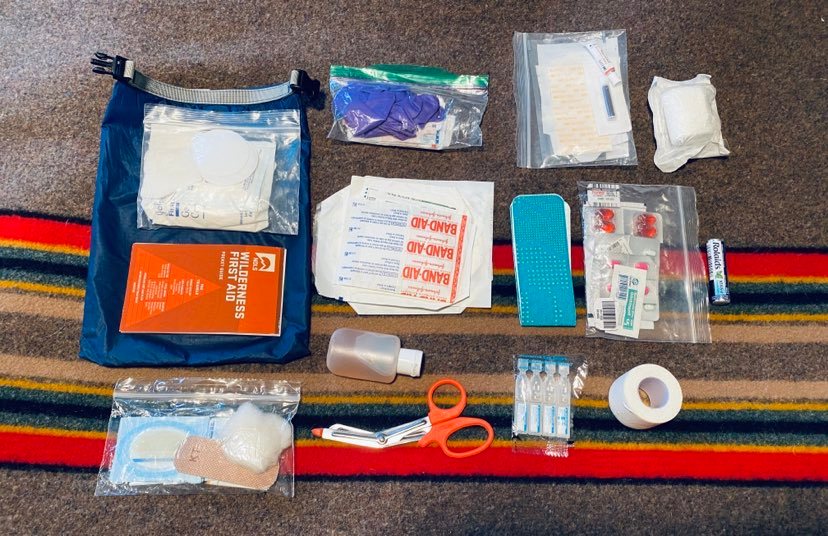
Years ago, I read an article in Backpacker Magazine about Ultra-Lite Backpacking. The author, a man who had some credits of long thru hikes to his name, was recalling his advice for cutting weight.
On the list? Omit a first-aid kit. His reasoning? He wrote that he adventured within his means, staying fit, being mindful etc….that his other gear was well tuned and therefor needed nothing for blisters or sprained ankles. His point was that beyond a roll of tape, if he required more than that he was going to be evacuated one way or another-no point in packing the weight.
I read that article over 10 years ago, and it has stuck with me…. every time I put a kit into my pack and lovingly cart it along hoping not to use it. And you know what? I often use it.
The last time I used my first-aid kit on an outing (you can read that post and watch the video from that trip here- https://daysoffadventureblog.com/2023/02/11/trip-report-colorado-sisters-trip-august-2022/ ) a stranger moving downhill with no trekking poles and Ugg like footwear slipped and stopped his momentum with his palm. The result was a small scratch that burned and bled. I offered a quick wipe and band-aid so he didn’t bleed on his clothes for the rest of the hike-simple. Could he have survived without it? Of course. Was he likely more comfortable and had an enjoyable rest of the hike because of it? I hope so.
The time before I was running a trail race-not super remote. In fact much less remote than planned due to flooding and we actually ran the same segment multiple times to reach our milage. The trail was rugged though, uphill and straight back down the same way. On one trip downhill we saw a girl on the side of the trail hugging her ankle. She had clearly rolled it, it was swelling already, and would not be able to continue. She told us she’d done that to her ankle before she wasn’t worried, and her friends were at the turn-around and would help her on their way back through. There was race provided help frequently along the course. She was clearly in pain. I had packed a small kit in my running vest-and offered her ibuprofen (following all appropriate guidelines for offering someone medication of course) to which she accepted making her wait hopefully more comfortable.
My point being-neither of those instances were life saving measures. I could have not packed my first-aid kit and life or limb would not be lost. But sometimes simple first-aid can mean the difference between staying alive, staying out or just staying comfortable. And for me? The last reason is enough.
First-aid also makes the list of 10 Essentials. You can read more about them here- https://daysoffadventureblog.com/2023/02/16/how-to-the-10-essentials/
Here’s my list of 4 Tips for packing a first-aid kit:
- Get Education: I can’t stress this enough. Wilderness Medical Institute (WMI) with the National Outdoor Leadership School (NOLS) is a wonderful nationwide resource. There are other organizations that I have heard great feedback on, but I have no direct experience with. I took my first First-Aid class more than 20 years ago, and I have been refreshing, and building on my medical knowledge and skills since then. As a Lifeguard, EMT, WFR and RN… I’ve taken a lot of classes with a lot of instructors. From direct experience I can tell you that the approach that NOLS takes to instructing first-aid is outstanding. A 2-day Wilderness First-Aid (WFA-Woofa) course is 16 hours, varies in price but is around $200-300, suggests renewal every 2 years and so worth it! It’s informative, surprisingly comprehensive and fun!!!
- Pack for the Activity: What do I mean by that? If I am going backcountry skiing, or mountain biking…those are both high velocity sports, through woods…the likelyhood of breaking a bone during those activities is greater than if I were canoeing. Therefore I will usually add a SAM Splint to my first-aid kit for those activities. If I am on a multi-day backpacking trip-blisters are much more likely, so I’ll amp up the blister care in my kit. So where I am going with this? Pack for your activity and group. If you are adventuring with small kids, your kit might include fun band-aids and lots of them.
- Re-Evaluate: This tip applies to all of your outdoor packing lists, but important when tuning your first-aid kit. When you get home and unpack, ask yourself…..”Did I need this? Could I have used more of this?” It’s also an important step in restocking your kit in case you did use something.
- Stay Organized: Another tip that applies to a broad spectrum. I like to pack my first-aid in a series of ‘kits’. Wound Kit, Blister Kit, Med Kit and so on. This helps me and others find things easily, and makes restocking easy too. This means packing a kit yourself, not buying a pre-made one from the store. But do what makes sense for your level of comfort. If buying and packing one is your comfort zone-do that! If finding a container that makes sense and piecing together your own is in your wheelhouse-do that!
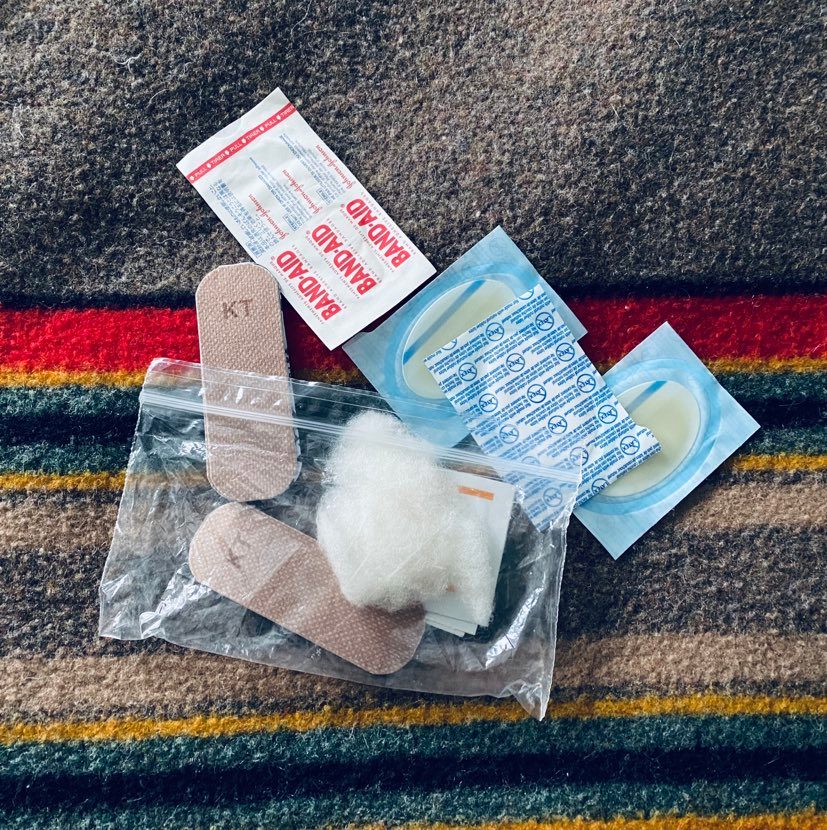
Over the years I’ve discovered a few things that I can not live without for (almost) any overnight activity. Here they are:
- KT Tape: You can get it or a generic from any pharmacy I’ve been to. This has been my blister preventer go to, as well as my joint pain fix. YouTube has several videos from KT Tape that have directions on application for areas of pain. Be smart, know your body, talk to your doctor….and love this tape.
- Athletic Tape: Some refer to this as hockey tape. Yes, I’ve listed tape twice already. Important items to have in your kit are things that are tough or impossible to replicate. Tape is pretty hard. If you run out of band-aids, but you have gauze and tape, socks and tape, a Buff and tape….you still have band-aids you see? Didn’t bring a splint but you have sticks, a sweatshirt and tape? You got a splint! See a trend? It’s small, cheap and a little roll can do a lot. “But why not duct tape?” If you have’t seen super strong tape adhere to skin, and then peel that skin from the body when you pull the tape off….you don’t need to.
- A Few key Medications: This is a slippery slope I won’t go too far down. I will say that I use ibuprofen and antacids the most out of my kit and consider them irreplaceable. Bugs an issue? A small tube of hydrocortisone might save your trip!
- Great Blister Care: This is huge, looks different for everyone and something I have fine tuned. I discussed KT Tape is part of that kit, as are a few KT branded items they make for blisters (get them here!)A waterproof bandage of some sort if I am on a water-based trip will seal the deal…seal…ha! Wool-the kind that ballerinas use in their point shoes, also makes for great blister protection. Glide or some other lubricant can be handy for those of us whose piggies rub on one another.
- Eye Care: I try and be very careful with my eyes-wearing sunglasses even if it’s not that sunny-especially depending on the activity. Fly fishing for example, my eyes are never naked. I do like to pack a small eye flush or at least some lubricated drops in case of something in the eye.
- Hand Hygiene: ie. Gloves and Sanitizer. I pack hand-sani many places. I think after the last few years, most people won’t argue with that. Global viruses aside….GI distress caused by dirty hands is one of the top reasons (along with blisters) that people get evacuated from the backcountry….keep your hands clean.
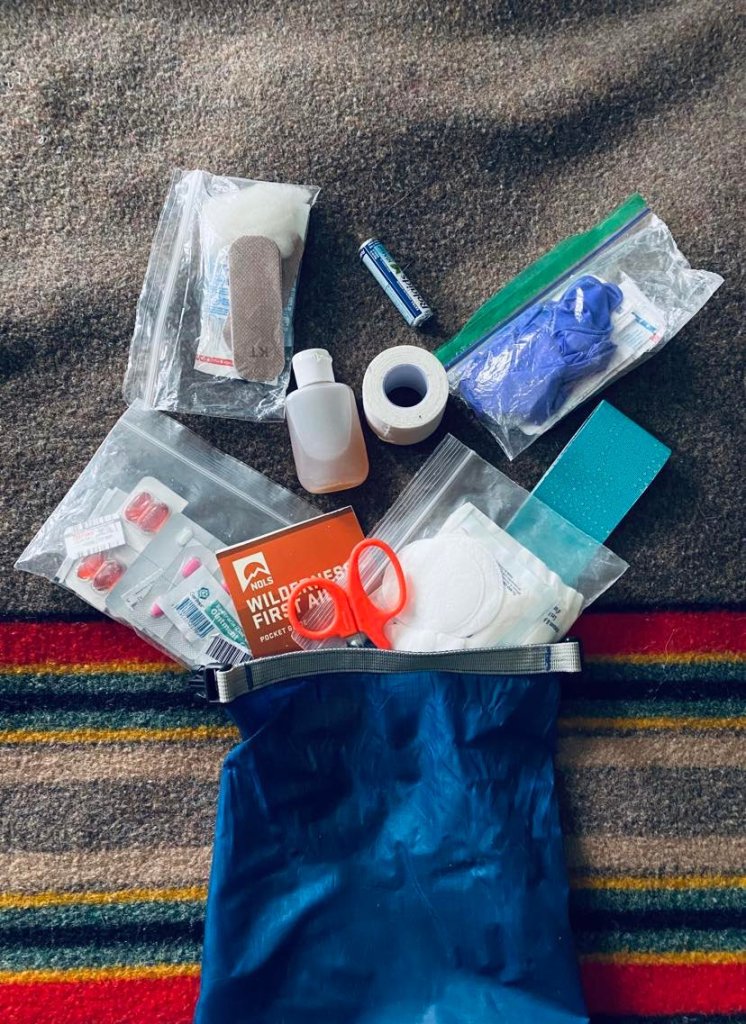
My regular overnight kit (above) is a 2.5 liter dry bag. As mentioned before, I tweak it some depending on activity. For a day hike, I have a small pouch that I’ll toss a few items in, mostly a few meds, gloves, and my blister kit. No bigger than about a snack sized plastic bag.
I can not claim expertise in this subject of course-so please heed my first piece of advise and get some education if you have not already.
I hope you enjoyed reading. If you’d like to know more, or have interest in a specific packing list, comment below and don’t forget to read my other posts, and follow for more advice and inspiration!
Thanks for stopping by, hope you can get out and (safely) enjoy some Days Off!
 daysoffadventureblog
Does the wilderness first aid pamphlet in the picture actually go with you? And where can I find one?
LikeLike
Yes! I have one in every first-aid kit! You can get one at NOLS.edu-click on the ‘store’ section!
LikeLike
[…] *https://daysoffadventureblog.com/2023/03/01/how-to-pack-a-first-aid-kit/ […]
LikeLike