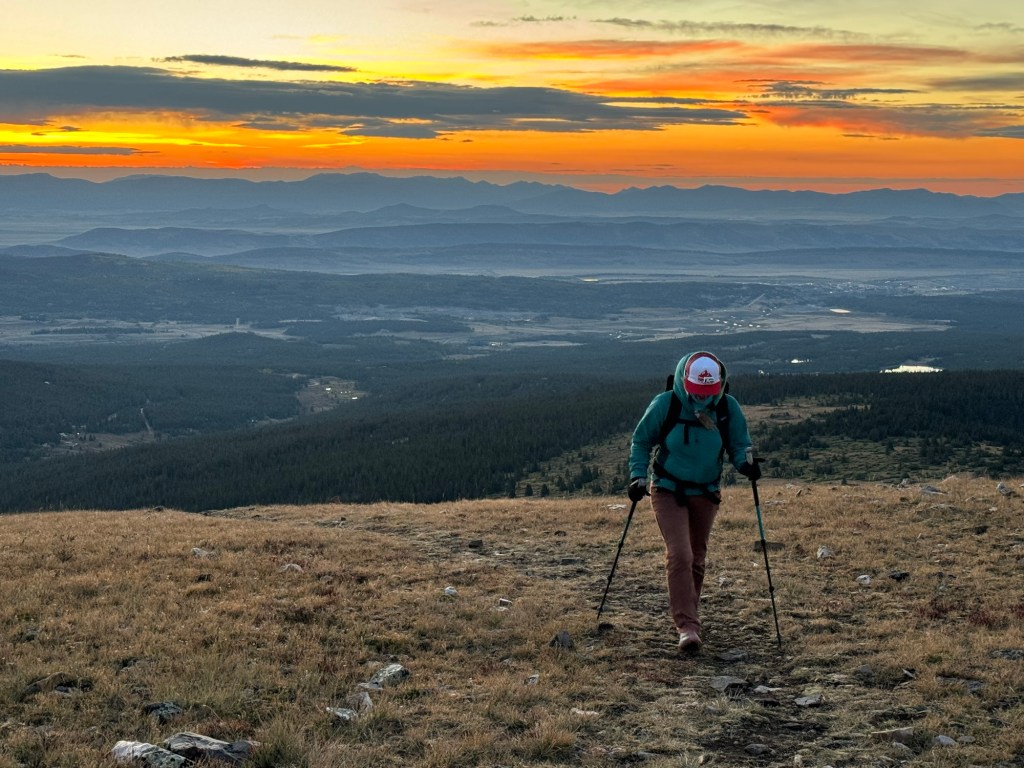
Trekking poles. What are they? Do you need them? What should you get?
This is an incredibly poorly followed blog if you haven’t already noticed. But among friends and family, I have the good fortune of being asked advice about gear. Picture it. You are me. Your phone *pings* that you have a message. It starts with “Hey, what are your thoughts about (insert gear item here). Have we all seen “You’ve Got Mail”? My breath catches in my chest.…I live for gear/trail questions. Trekking poles are actually a topic I’ve been asked about, that I haven’t written about. So here goes!
Hiking poles, trekking poles, walking sticks….I don’t care what you call them. Do I think they are amazing and everyone would benefit from them? Yes.
Ever been hiking….for a while….your hands start to hurt a bit from swinging at your sides? You look down to see your fingers have been replaced with sausages? You try tucking your thumbs under your shoulder straps-but then your thumbs just hurt and you can’t take a deep breath on the uphill, and you totally loose your cadence? Thats what trekking poles are for.
Trekking poles have the amazing ability to not only offer you stability on the downs, assistance with the ups but also you give you speed on the flats. Plus-since the appropriate height/length for trekking poles keeps your hands close to heart height (your hands should be level or a little higher than your elbows and bent to about 90 degrees) they also keep your fingers from swelling up. I’ve loved trekking poles-Brandon too. Since ACL surgery however, they have become incredible allowing me to feel comfortable on terrain that I wouldn’t otherwise feel comfortable in for while.
I think of trekking poles in 2 (maybe 3) main groups.
Group 1 is trekking and long distance (ultra) trail running. Think light weight, several days at a time, speed is of the essence….
Group 2 is hiking. Backpacking, day hiking. I think this also includes Group 3 which is seasonal use. ie Winter. Snowshoeing, mountaineering…
I think of Group 1 as being fixed length poles and Group 2 as being adjustable in length.
Group 1. Ultra runners tend to use light weight poles that can be quickly deployed and stowed with a shock cord system. They are light weight and fold small when not in use. Easy to stow on a running belt for flat stretches for example.
Group 2 is adjustable in length, telescoping. While you buy certain lengths you can still make micro adjustments to what you want. This means adjusting them longer for a downhill and shorter for an uphill….or longer if you are wearing ski or mountaineering boots and are sitting taller than is typical.

Materials:
Either way, poles are typically made from 1 of 2 lightweight materials.
More rugged but slightly heavier aluminum. ($$)
Or ultra light weight but less sturdy carbon fiber. ($$$)
In general, I think most people are best suited for something in Group 2. If you are an ultra runner, or preparing for a cross country trek you likely have something specific in mind. There is a balance between weight and budget and you are finding out what that is.
The average Weekend Warrior is looking for a trekking pole to use backpacking on the Superior Hiking trail, High Pointing the 50 States, tackling a Colorado 14er, a weekend in the Grand Canyon or day hiking anywhere in this amazing world we live in. It might also mean, having a pole to use touring on skis, snowshoeing through the Boundary Waters or for mountaineering before transitioning to an ice tool. We like to do all of those things-and we use 1 set of poles for all of them.

My 2 favorite brands are Black Diamond and Leki. Leki has a reputation of making amazing poles and not much else. Black Diamond makes mountain equipment. From climbing gear like harnesses and pro, to mountaineering tents and downhill skis.
If you are looking for something in Group 1-again, fixed length, lighter weight in general you can get these from Leki for around $150 and 250g or these from Black Diamond for around $140 and 330g. Both aluminum options.
Carbon fiber from Black Diamond can get you these for just over $200 and just over 300g or for $250 and only 228g you can have yourself a pair of these from Leki. It’s all a trade off between cost and weight. If you haven’t read my post about tents, head there now to see what I mean about finding a balance in what you are looking for.
If you are choosing from Group 2, you are looking for an all-around performer….the Jack of All Trades….the life is too short to choose one hobby and I can’t have separate poles for all the sh*t I like to do…..kind of pole.
In this category you have a few options. Like before-aluminum vs carbon. And also cork handle vs plastic and the added option of shock absorption.
I find the shock absorption to be excess. Not necessary. More often than not I find myself hiking on soft surfaces and poling fairly lightly. If anything I’d want the shock absorption in a distance pole, when I might find myself on a path at times but I don’t tend to see that as an option.
Our vote will also be aluminum. While we use our poles for backpacking and day hiking where shaving weight is key, we also like to use them in the winter and on tall mountains when they might be used as an anchor at camp. We can’t rely on carbon for this purpose. Aluminum is acceptably light weight with great durability, which for us makes it a great all around and long lasting buy.
My first pair of poles (a cheap-actually Junior set due to my height) lasted a while and had plastic handles. Brandon convinced me to get cork when it was time to replace them and I am so happy. Holy comfort Batman. In chillier temps, softer….warmer temps….not sweaty or slippery…..I love them.
If you are looking at Leki, the Makalu series is a great option. Part of their ‘cork light’ series. It has a wide range of length adjustment, so is likely to fit the most about of people. It has everything to check off the list: Cork handle, flip lock adjustments and aluminum. A great all around performer for 254g and $149.
Similarly, Black Diamond’s all around performer is their Trail Cork pole and again checks all the boxes at 495g (a pair) and $119. Cork handle, flip lock adjustments and aluminum. Black Diamond poles also come with winter use snow baskets, wider baskets for use in deeper snow for thinkings like snowshoeing or ski touring. Leki poles seem to have a nicer wrist strap adjustment system….little details you can use to help you choose.
While we’re talking about snow baskets….thats one of the reasons trekking poles are such a versatile piece of gear. Its what makes them more than just hiking poles. We’ve brought trekking poles on every one of our PNW volcano summits. The lower half of the mountain is a hike. Trail shoes, packed snow, heavy packs….miles. Poles add stability, comfort and speed. But they get left at camp as we transition to mountaineering and favor an ice axe. But they don’t just sit at camp. They are usually sequestered to the role of tent stake. At 10,000 ft, tent stakes don’t really work as designed. Rocks, packed snow and you guessed it-trekking poles make the best anchors. One of the reasons we favor aluminum over carbon-the durability.
As fall transitions to winter and we look to keep outside, snow shoeing is one way we do that! With a quick twist on of the snow baskets-we’re set, no need for a second set of poles.
As you can tell…..we love our trekking poles. A nice pair should add to your outdoor life for years to come-get them and let us know what you think?
Other gear questions you want to ask about it? Buyers guides you want to see? Let me know!
We’re gearing up for an eventful season this summer and my knee continues to heal, follow along to see what happens!
Thanks for reading, it’s warming up around here-enjoy getting out living some Days Off!
 daysoffadventureblog