
Skills.
Who has seen “Six Days, Seven Nights”? The late Anne Heche, Harrison Ford….
“Aren’t you one of those guys? Those guys with skills?”
“Skills?”
“Yeah-you know. You send them into the wilderness with toothpick and a pocket knife and they build you a shopping mall-you can’t do that?”
Great movie *pause to appreciate in your memory or to go see it now-I’ll wait*
Skills are an important part of any outdoor adventure-but a backcountry adventure in the wilderness is a different scenario all together. This post is dedicated to a few skills I encourage you to either brush up on before your trip, or fine tune depending on your current ability.
The BWCA is a remote wilderness area. Cell service is non-existent, and the draw for most people is the seclusion that bodies of water divided by thick forest affords them. This means that if you get into trouble-help may not find you. It can be a scary place that can claim lives. You’re best course of action? Act smart-avoid trouble and you will avoid rescue that is both financially and ecologically costly.
Skill #1 First-Aid: I have a post about putting together your first-aid kit and touch on the importance of education there as well. https://daysoffadventureblog.com/2023/03/01/how-to-pack-a-first-aid-kit/
But I can not stress enough that a 16 hour course can change your life!!!! Wildness First-Aid (WFA-woofa) is a 2-day 16 hour course offered through a few agencies, most popular is through NOLS (National Outdoor Leadership School). In this course you’ll learn the basics of patient assessment, treatment of common illnesses and injuries that occur in the backcountry, and even dive into evacuation protocols. You’ll gain confidence through practice, have the opportunity to ask questions and even pare down items you might decide to always have with you-while you learn to improvise items that you won’t!
There are several options for even higher levels education-truthfully I find this to be a minimum.

Skill #2 Navigation: This skill fights with the number 1 spot. As I mentioned, like most backcountry areas, there is no cell reception. The last cell tower is outside of the wilderness zone and can loam some coverage close to the border-but your phone will not help you here. Keep in mind-this is a water based location. Relying on electronics is a dicey gamble when you consider having to keep items dry.
GPS devices are tough to rely on as well. Specific maps must be downloaded, and because you travel on water and then through dense tree coverage through portages-friends have told me they aren’t very accurate. I do not rely on GPS when traveling in the BWCA.
Good ‘ole Map and Compass is the way to go! REI offers classes around the nation on map/compass navigation that teach; map reading, map and field bearings and are wrapped up with a lot of practice. Everything you need. Our local park system also offers classes. If you don’t have experience with a map/compass or it’s been a few decades (I see you Cub Scouts…) take a class. And practice!
My navigation tips?
Don’t forget to orient the map to you; when you get to the end of a portage before setting off. Correctly orient the map to your view by using north on your compass and north on the map. This will represent the world you see in front of you, accurately on the map. It is too easy to think you see the other side of the lake and choose a location on your map, when really you are seeing a series of islands next to you.
Confirm your location often. When you paddle past a shallow bay, check it against your map. When the map says you should be nearing an inlet creek-keep your ears pealed for running water. Pay attention to high points on land masses that will represent hills or cliffs in real life.
If you Google ‘map and compass skills’ the first hit is from REI. It’s really a pretty good resource, including a video. Head to that page (link below) and if the information doesn’t make sense as just a refresher-I’d recommend getting into a class.
https://www.rei.com/learn/expert-advice/navigation-basics.html
Skill #3 Paddling: If you read our ‘Nice to Meet You’ post-you know Brandon and I met while paddling canoes and kayaks. Fortunately this is a skill we both already possessed before meeting and can trust each other to stern a canoe at anytime. This is a huge benefit for us. When we finish a portage, if it makes sense for me to stern, I will. With a fully loaded canoe there isn’t even much weight discrepancy to determine locations for us.
A favorite pastime at camp? If we happen to be in a location where people travel past, we love to watch and comment on the proficiency of their paddling. No judgement, just observation. Great paddling skills aren’t required for a successful trip-years of observation have proved that. Minimally good skills are required though. Good skills will keep you safe, great skills will keep you efficient. Depending on the type of boat you have, you might be able to get away with less desirable skills.
Kevlar canoes are incredibly lightweight and fast. Often models are longer and slimmer, designed for expedition travel. This means they are less stable and also more fragile. Running them ashore isn’t an option (most shorelines are rock anyway) so being able to pull your boat parallel to the land for exit is essential. We baby our canoe (I’ve been known to check on her during thunderstorms, even at home) wanting it to last for many decades-so we are very careful not to gouge or scratch it while entering and exiting. This also means our feet are always wet-but that’s another topic. Plastic (vinyl) canoes you can get away with must less finesse, same is true with aluminum. Of course you pay for it in weight.
If paddling a canoe is not in your wheelhouse, take a class! Again our local park system offers classes. YouTube is also a decent resource if you have a boat you can take onto the water to practice.
My paddling tips?
The person in the bow (that’s the front) is the power-the rear (or stern) is the person who steers.
Whenever possible you are the most efficient and balanced by paddling on opposite sides of the boat.
As the person in the back, you should not have to change sides to steer.
As the person in the back, your actions dictate the the bow of the boat. If paddling on the right side you can move your paddle directly left or right (moving water away from the boat or towards the boat). Practice this. Watch what happens to the bow. While paddling on the right, reach away and move water towards the boat-it will pull the bow to the left. If you move water away from the boat, it will kick the bow right. I find a lot of people get stuck in the ‘J’ stroke. If you watch any videos on steering a canoe you are sure to find it. I have discovered people are most successful thinking of steering and moving the boat forward, with a series of adjustment strokes that move the bow from one side to the other.
First-Aid, Navigation and Paddling are the big skills I have found to be successful in the BWCA. Not to be discounted however are skills in tarp rigging, fire starting and hanging a bear bag.
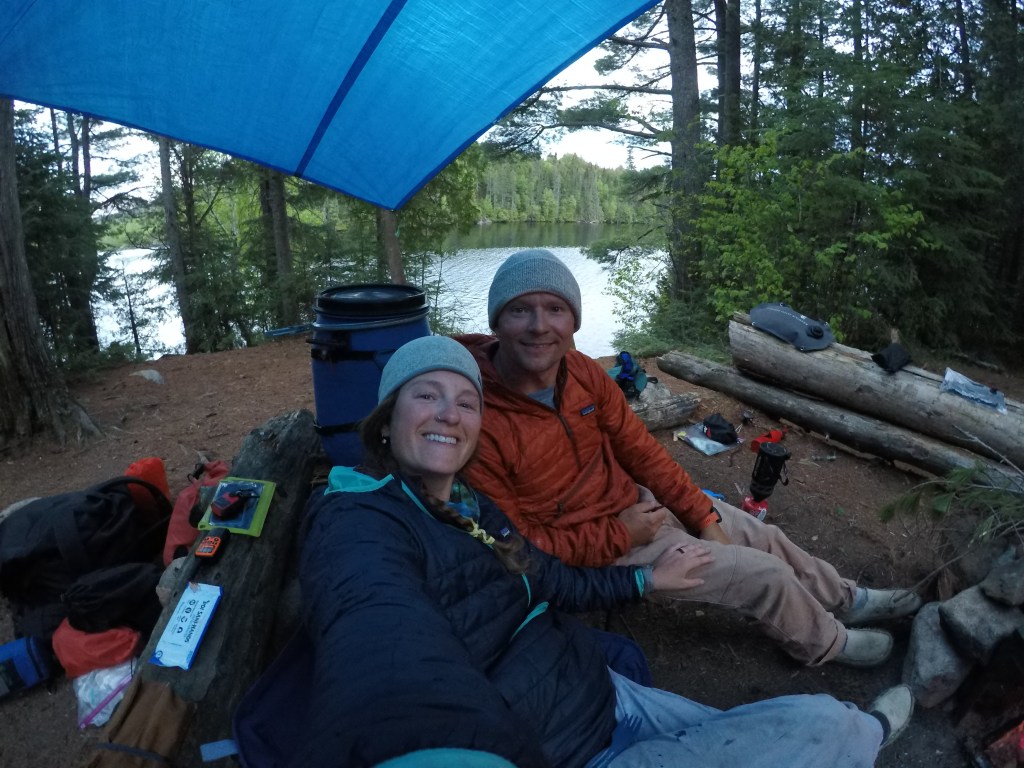
Tarp rigging can be difficult. A lot of your success depends on choosing the right campsite-one with appropriate trees for use with tarps! You can buy specialty and lightweight tarps-we would not recommend this for the BWCA. We use a tarp to stay dry when it inevitably rains at camp, and you are forced to huddle under it with your headlamp to eat a dinner at the very least. We use a tarp to keep the fire pit and any collected firewood dry. This means our tarp usually ends up with micro burn holes. Not something I’d be willing to risk with an expensive tarp. The blue tarps from the hardware store have worked for us for years. We don’t bring a huge one-it’s not that heavy, and the grommets also make it easier to rig. Most important? Put up the tarp when you get to camp-when the weather is nice and the stakes are low.
Fire starting is also an important skill-note that at times there are burn bans in the Northwoods so never plan on cooking over a fire. We like to have a fire most nights to keep the bugs at bay, have something to gather around, keep us warm after the sun goes down and I have been known to pack s’mores supplies! We like to bring fire starters I make at home (more on that later-check out our Instagram account) to help the process along, and collect fuel responsibly for having a fire. A small saw works well for creating small enough fuel to fit under the fire grate.
Remember a good fire needs 3 things: Ignition, Fuel and Air! Adding fuel seems like a great idea but can easily choke out a fire with inadequate air. Blowing on your fire seems like a great plan to, as long as it is under control and has the fuel onboard to support it!
Black bears are present in the Northwoods. Though if you keep a clean camp-unlikely to be an issue for you. Last fall we did see a lot of warnings about bear activity in specific locations, and saw some of that activity (damage) with our own eyes. Keeping your food tucked away in a bear proof container, or in a tree is the only place it should really be stored. Not in your tent, not left at camp while you fish…but stored appropriately. Finding a tree burley enough for the weight of our food, far enough from other limbs and away from camp can be tricky. Most times we opt to secure a bear proof, hard sided container instead. If we suspect more bear activity-we will also deploy smell proof bags for food storage.
Be sure you have the right supplies for securing your food (ie, plenty of strong rope) and practice at home. Just like the tarp-the time to rig your line is in the daylight, well before you need to get your food in the tree.
These are just a few examples of tips we think help to make a great trip and are often a big part of your time in the wilderness. Remember you can always look to a guide service if you want to gain some skills before going yourself!
If you liked this post-share it with a friend, subscribe to the blog and give us a follow on Instagram. Comment below if you have questions or things you’d like to hear about!
Thanks for reading folks, as always I hope you get a chance to enjoy some Days Off!
 daysoffadventureblog